
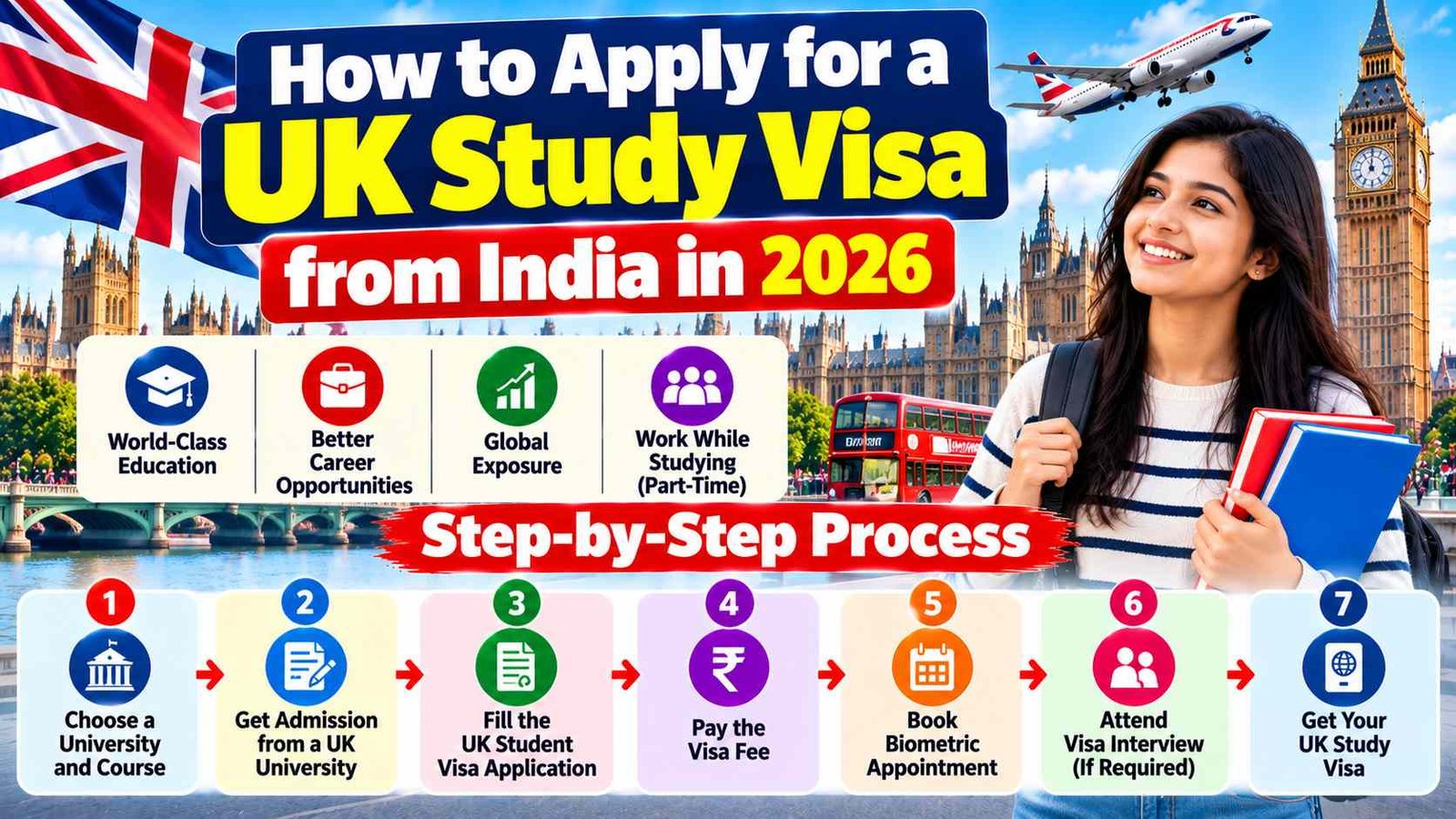
The United Kingdom is a popular destination for Indian students who want to pursue higher education and gain international academic experience. UK universities offer undergraduate degrees, postgraduate courses, master’s programs, research degrees, and professional qualifications in a wide range of subjects.
Before travelling to the UK for education, eligible Indian students generally need to obtain a UK Student visa. The process involves choosing a university, securing admission, receiving a Confirmation of Acceptance for Studies (CAS), arranging financial evidence, completing an online visa application, and proving their identity.
In this guide, you will learn how to apply for a UK study visa from India in 2026, including eligibility requirements, documents, fees, bank balance, the application process, and important official links.
1. What Is a UK Student Visa?
A UK Student visa allows eligible international students to study an approved course with a licensed student sponsor in the United Kingdom.
It is commonly used by international students pursuing eligible university degrees and other qualifying courses. The visa conditions depend on the course, the institution, and the student’s individual circumstances.
Before applying, confirm that your chosen institution is authorised to sponsor international students.
2. Types of UK Study Visas
UK Student Visa
The Student visa is generally used by international students aged 16 or over who meet the requirements for an eligible course.
Child Student Visa
The Child Student visa is intended for eligible students aged 4 to 17 who want to study at an independent school in the UK.
Short-Term Study Visa
A Short-term study visa may be appropriate for eligible English-language courses lasting more than six months and up to 11 months. It has different conditions and does not provide the same rights as the main Student visa.
Choose the visa category that matches your course and circumstances.
3. Eligibility Requirements for a UK Student Visa from India
Admission to a Licensed Student Sponsor
You must have an offer for an eligible course from an institution authorised to sponsor students under the UK immigration system.
Check your institution’s status before paying deposits or making travel arrangements.
Confirmation of Acceptance for Studies (CAS)
After meeting the institution’s requirements, you will generally receive a CAS reference. You need this reference to apply for your Student visa.
The CAS contains information about your course and sponsoring institution. Check the details carefully before submitting your application.
English Language Requirements
You must meet the English-language requirement applicable to your course and circumstances. The evidence may involve an approved English-language test, an eligible academic qualification, or another permitted method.
Your university can explain its admission requirements, but you should also confirm the relevant immigration rules.
Financial Requirements
You must demonstrate that you can pay the required course fees and support yourself in the UK, unless a specific exemption applies.
Age Requirements
Applicants generally need to be at least 16 years old for the main Student visa. Students aged 16 or 17 may have additional consent requirements.
4. Documents Required for a UK Study Visa
Prepare the documents relevant to your application.
- Valid passport or other accepted travel document
- CAS reference number
- Financial evidence, if required
- English-language evidence, where required
- Tuberculosis (TB) test certificate, if required
- ATAS certificate, if required for your course
- Parental or legal guardian consent for eligible applicants under 18
- Evidence of relationship to a parent or guardian, where applicable
- Financial sponsor consent, if required because of recent official sponsorship
- Other supporting documents requested by UK Visas and Immigration
Not every applicant needs every document. Follow the current official checklist for your particular circumstances.
5. How to Apply for a UK Study Visa from India Step by Step
Step 1: Choose a UK University
Research universities and colleges that offer your preferred course. Compare tuition fees, entry requirements, course duration, scholarships, accommodation, and living expenses.
Make sure the institution is authorised to sponsor students.
Step 2: Apply for Admission
Visit the university’s official website and submit an application for your chosen course.
You may need academic transcripts, degree certificates, English-language test results, recommendation letters, a personal statement, and other documents.
Admission requirements vary by institution and course.
Step 3: Receive Your CAS
After the institution confirms that you meet its requirements, it may issue your Confirmation of Acceptance for Studies.
Review the CAS details carefully. Contact the university if you notice an error in your personal details, course information, or financial information.
Step 4: Arrange Your Financial Evidence
Calculate the amount required for unpaid course fees and living expenses.
If you are using personal or family funds, make sure the evidence meets the official rules. If you are using a student loan or eligible official sponsorship, obtain the relevant supporting documentation.
Step 5: Check Whether You Need a TB Test
Indian applicants applying for a UK visa for a stay of six months or longer will generally need a TB test if the relevant residence requirements apply.
Use the official UK government guidance to find an approved clinic and confirm the requirements before arranging the test.
Official guidance: https://www.gov.uk/tb-test-visa
Step 6: Complete the Online Visa Application
Apply through the official UK government Student visa page.
You will need to provide personal information, passport details, your CAS reference, and other information requested by the application.
Review your answers carefully before submitting the form.
Official application page: https://www.gov.uk/student-visa/apply-online
Step 7: Pay the Visa Application Fee
Pay the applicable Student visa fee using the payment instructions provided during the official application process.
The fee can change, so confirm the current amount before paying.
Step 8: Pay the Immigration Health Surcharge
Most Student visa applicants must also pay the Immigration Health Surcharge (IHS), unless an exemption applies.
The amount depends on the visa duration and applicable rules. Use the official application process to calculate the amount due.

Step 9: Complete Identity Verification and Biometrics
Follow the instructions given during your application. Depending on the process available to you, you may need to attend a visa application centre for biometrics and document-related procedures, or use another approved identity-verification method.
Use the official instructions for applicants in India.
Step 10: Wait for the Decision
After completing the required steps, monitor your application through the official channels.
The usual decision time for applications made outside the UK is around three weeks, but individual cases may take longer. Avoid making non-refundable travel arrangements until you have received the appropriate decision.
6. UK Study Visa Fees from India in 2026
The main costs may include:
| Expense | What to know |
|---|---|
| Student visa application fee | GOV.UK currently lists £558 |
| India application fee equivalent | The official fee calculator currently lists ₹74,213 |
| Immigration Health Surcharge | Depends on visa duration and applicable rules |
| TB test | If required, charged separately by an approved clinic |
| University application fee | Depends on the institution |
| Tuition fees | Depends on the course and university |
| Travel and accommodation | Additional expenses |
The rupee amount can change because of official exchange-rate updates. Always check the live fee calculator before paying.
Official fee calculator: https://visa-fees.homeoffice.gov.uk/
7. How Much Bank Balance Is Required for a UK Student Visa?
There is no single fixed bank balance for every Indian student. The amount depends on your unpaid course fees, where you will study, and the applicable financial rules.
Studying in London
The current living-cost requirement is £1,529 per month for up to nine months.
For a nine-month period, this equals £13,761, in addition to any required unpaid course fees.
Studying Outside London
The current living-cost requirement is £1,171 per month for up to nine months.
For a nine-month period, this equals £10,539, in addition to any required unpaid course fees.
How Long Must the Money Be Held?
For standard bank-fund evidence, the required funds generally need to remain available for 28 consecutive days. The end of this period must fall within 31 days of the visa application date.
Specific exemptions and alternative evidence rules may apply.
Can Parents Sponsor a UK Student?
Yes, eligible students may be able to rely on a parent’s funds. Additional evidence, such as proof of the relationship and the parent’s written consent, may be required.
Can an Education Loan Be Used?
An eligible student loan may be accepted if it meets the applicable requirements. Obtain the official loan documentation and ensure that it contains the required information.
Important: Do not rely on temporary deposits or misleading financial documents. Use genuine evidence that complies with the current rules.
8. UK Student Visa Interview and Credibility Questions
Some applicants may be asked questions about their study plans, course choice, funding, and intentions.
Why Do You Want to Study in the UK?
Explain how the course relates to your educational background and genuine career goals.
Why Did You Choose This University?
Mention real details such as the curriculum, relevant facilities, course structure, or academic specialisation.
Who Will Pay for Your Education?
Explain your genuine funding arrangement, whether it involves personal savings, family support, an eligible education loan, or official sponsorship.
What Are Your Plans After Completing the Course?
Describe your actual plans and explain how the qualification fits your longer-term goals.
Answer honestly and consistently with your application. Never submit false documents or memorise misleading answers.
9. UK Student Visa Processing Time
For applications made outside the UK, the usual published processing time is around three weeks after the required steps have been completed.
However, the actual time may depend on application volume, document verification, additional checks, and other circumstances.
Apply early enough to allow time for admission, CAS issuance, financial preparation, testing, and visa processing.
Check the current processing information here:
10. Can Indian Students Work on a UK Student Visa?
Some students may work while studying, but the permitted hours and conditions depend on the course, sponsor, and visa conditions.
Eligible degree-level students at certain institutions may be allowed to work up to 20 hours per week during term time and full-time during permitted vacations. Other students may have more restrictive conditions.
Check the work conditions stated in your immigration permission. Do not assume that every Student visa holder has the same work rights.
Self-employment and certain types of employment are prohibited under the Student route.
11. Can You Bring Dependants on a UK Student Visa?
Dependant eligibility is restricted and depends on the course and sponsorship circumstances.
In general, some students on eligible postgraduate research-based courses or certain government-sponsored courses may qualify to bring a partner or children. Many students on ordinary taught courses will not qualify under the current rules.
Check the latest dependant requirements before making family travel plans.
Official guidance: https://www.gov.uk/student-visa
12. What to Do After Your UK Student Visa Is Approved
Once your application is successful:
- Check your immigration decision and travel document details.
- Follow the instructions for accessing your eVisa and UKVI account, where applicable.
- Confirm your university’s course start date and enrolment instructions.
- Arrange accommodation and travel.
- Keep your passport, CAS details, university documents, and relevant financial records accessible.
- Check the date from which you are permitted to travel.
- Follow the conditions of your immigration permission after arrival.
A visa does not remove the need to comply with UK immigration rules.
13. Official Websites for UK Study Visa Applications
Use these official resources to verify the latest rules and fees.
- UK Student Visa Information: https://www.gov.uk/student-visa
- Apply Online: https://www.gov.uk/student-visa/apply-online
- Student Visa Documents: https://www.gov.uk/student-visa/documents-you-must-provide
- Financial Requirements: https://www.gov.uk/student-visa/money
- Visa Fee Calculator: https://visa-fees.homeoffice.gov.uk/
- TB Test Requirements: https://www.gov.uk/tb-test-visa
14. Frequently Asked Questions (FAQs)
Can I apply for a UK study visa from India without IELTS?
Possibly. IELTS is not the only way to meet the English-language requirement. Other evidence may be accepted depending on your circumstances, qualification, course, and institution.
How much does a UK Student visa cost in 2026?
GOV.UK currently lists the application fee as £558. The official fee calculator currently lists the equivalent India fee as ₹74,213. The Immigration Health Surcharge and other expenses are additional.
How much bank balance is required for a UK Student visa?
You generally need enough money for unpaid course fees and the applicable living-cost requirement. The current monthly amount is £1,529 in London or £1,171 outside London, for up to nine months.
Can I apply for a UK Student visa without an agent?
Yes. You can apply directly through the official UK government website. An agent is not compulsory.
Is a TB test required for Indian students?
It is generally required for applicants staying six months or longer when the relevant residence requirements apply. Check the official guidance and use an approved clinic.
How long does it take to get a UK Student visa?
The usual published decision time for applications made outside the UK is around three weeks, although some applications take longer.
Can I work while studying in the UK?
Eligible students may be permitted to work under specified conditions. Your course, institution, and visa conditions determine the applicable restrictions.
Can I bring my spouse or children to the UK?
Only eligible students can bring dependants under the current rules. Eligibility is restricted, so check the official guidance before applying.
15. Conclusion
Applying for a UK study visa from India in 2026 involves choosing an eligible university, obtaining a CAS, arranging financial evidence, completing the online application, paying the required fees, and meeting identity-verification requirements.
Prepare your documents carefully and ensure that your financial evidence reflects your genuine circumstances. Because immigration fees and requirements can change, always check the official UK government website before submitting your application.
With proper planning and accurate documentation, you can make informed decisions about studying in the United Kingdom.