
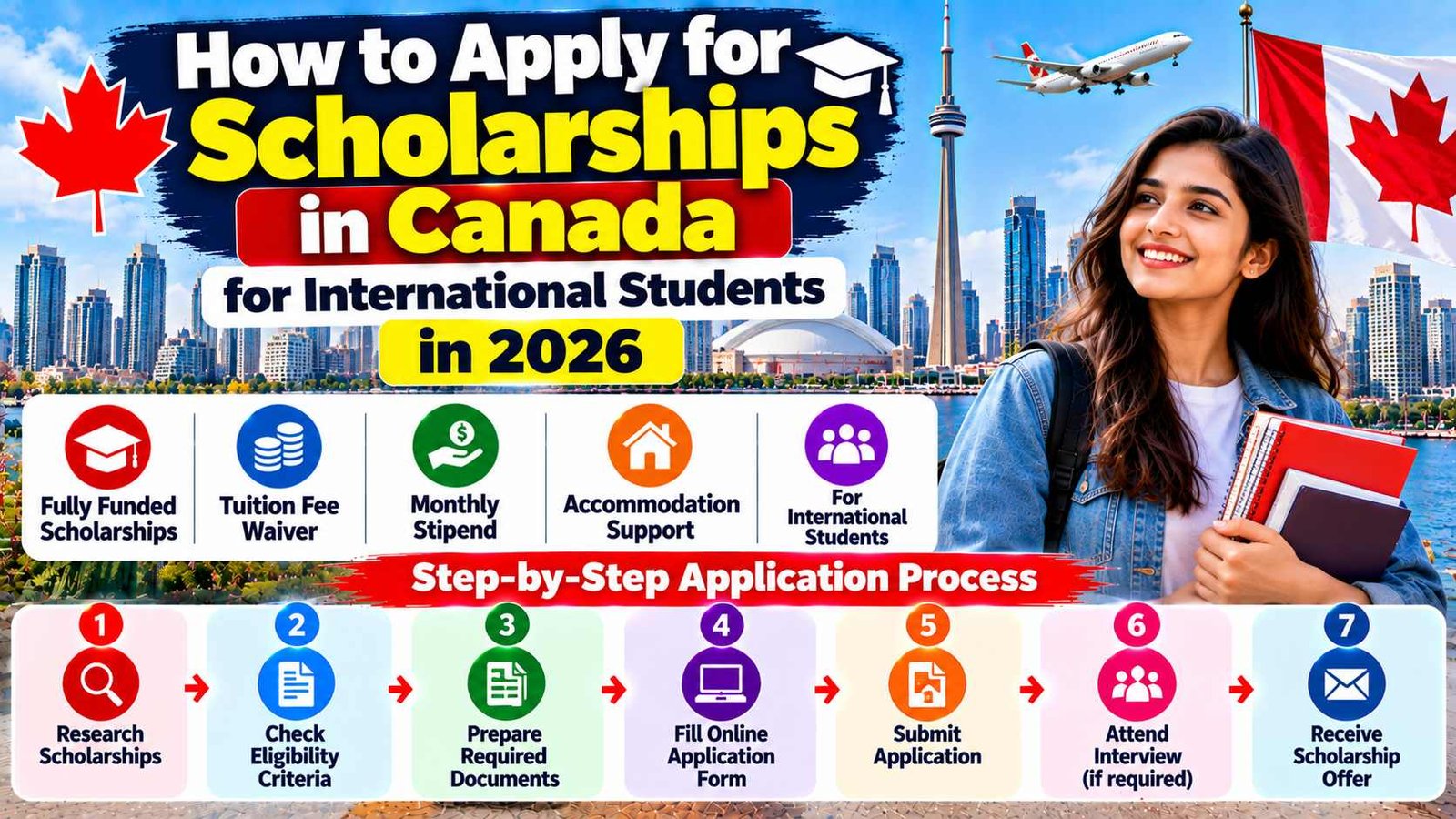
Studying in Canada is a popular goal for international students because Canadian universities and colleges offer a wide range of academic programs, research opportunities, and financial assistance options. However, tuition fees and living expenses can be expensive, especially for students coming from countries such as India.
The good news is that international students can explore university scholarships, merit-based awards, research funding, graduate assistantships, and selected government-sponsored scholarship programs.
In this guide, you will learn how to apply for scholarships in Canada for international students in 2026, including eligibility requirements, application steps, required documents, scholarship websites, and tips for finding suitable funding.
1. What Is a Scholarship in Canada?
A scholarship is financial assistance awarded to students to help pay for their education. Depending on the award, it may cover part of the tuition fees or provide additional funding for research and living expenses.
International students can explore several types of scholarships in Canada.


Merit-Based Scholarships
These scholarships recognize academic performance, leadership, extracurricular activities, or other achievements. Some universities automatically consider eligible applicants, while others require a separate application.
Need-Based Financial Assistance
Some institutions provide financial assistance based on a student’s financial circumstances. Availability and eligibility for international students vary by institution.
Fully Funded Scholarships
A fully funded award may cover tuition, living expenses, travel, or other approved costs. The exact coverage depends on the scholarship program, and such awards can be highly competitive.
Graduate Research Funding
Students applying for master’s or doctoral programs may be eligible for research grants, teaching assistantships, research assistantships, or departmental funding.
These opportunities are particularly worth investigating if you plan to pursue a research-based graduate degree.
2. Who Can Apply for Scholarships in Canada?
International students may qualify for scholarships if they meet the requirements of the university or funding program.
Common eligibility requirements include:
- A strong academic record.
- Completion of the required previous qualification.
- Admission to an eligible Canadian university or college, if required.
- English or French language proficiency, where applicable.
- Academic transcripts and educational certificates.
- A statement of purpose or research proposal, if required.
- Letters of recommendation, where applicable.
- Evidence of financial need for need-based awards.
- Relevant research experience or professional achievements for selected programs.
Eligibility varies by scholarship, degree level, citizenship, and academic subject. Always confirm that the award accepts applicants from your country.

3. How to Find Scholarships in Canada
Start with official Canadian scholarship resources and the websites of individual universities.
1. EduCanada Scholarship Search
Search for international scholarship opportunities by citizenship, applicant profile, and country.
Search scholarships on EduCanada
2. Scholarships for International Applicants
Explore scholarships and educational exchange opportunities administered or promoted by Global Affairs Canada.
Visit the official scholarship portal
3. Canadian University Websites
Visit the official admissions, graduate studies, or financial aid page of each university. Look for sections titled “International Scholarships,” “Graduate Funding,” or “Awards and Bursaries.”
4. Government of Canada Scholarship Information
Explore the federal government’s scholarship and funding information for eligible international applicants.
Important for Indian students: Not every Canadian government scholarship is open to Indian citizens. For example, eligibility for the Study in Canada Scholarships program is limited to specified countries and participating institutions. Check the current country list and program rules before applying.
4. How to Apply for Scholarships in Canada Online
Follow these steps to apply for a suitable scholarship.
Step 1: Choose Your Course
Decide which qualification you want to pursue:
- Bachelor’s degree
- Master’s degree
- PhD or doctoral degree
- Research program
- Other eligible academic programs
Choose a subject that matches your previous education, interests, and career goals.
Step 2: Select Canadian Universities
Prepare a list of universities that offer your preferred course and provide funding opportunities for international students.
Compare tuition fees, admission requirements, scholarship availability, living costs, and application deadlines.
You can also use the official EduCanada Study in Canada resources to research programs and educational institutions.
Step 3: Check Scholarship Eligibility

Read the official scholarship requirements carefully.
Confirm the following:
- Whether international students are eligible.
- Whether applicants from your country can apply.
- Whether admission is required first.
- Whether a separate scholarship form is necessary.
- Whether the scholarship covers tuition, living costs, or both.
- Whether there are academic or language requirements.
Step 4: Prepare Your Documents
Collect your academic records, certificates, passport, CV, recommendation letters, and other documents specified by the university.
If you are applying for a research program, you may also need a research proposal and information about your research interests.
Step 5: Apply for University Admission
Complete the university’s online application form and upload the required documents.
Some universities automatically consider eligible students for entrance scholarships. Other institutions require a separate scholarship application.
Pay attention to the admission and scholarship deadlines because they may be different.
Step 6: Submit the Scholarship Application
Complete the scholarship form and provide any required essays, financial information, academic achievements, or supporting documents.
For government-sponsored exchange scholarships, the Canadian host institution may be responsible for submitting the application rather than the student applying directly.
Step 7: Track Your Application
Check your email and university application portal regularly.
Respond to requests for additional documents or information before the deadline.
Step 8: Accept the Scholarship Offer
If you receive an award, review its terms carefully.
Check the scholarship amount, duration, tuition coverage, renewal conditions, and any remaining expenses you must pay.
5. Documents Required for Canadian Scholarships
The required documents depend on the university, scholarship, and degree program. Commonly requested documents include:
| Document | Purpose |
|---|---|
| Academic transcripts | To evaluate academic performance |
| Educational certificates | To verify previous qualifications |
| Passport | To confirm identity and citizenship |
| Statement of Purpose (SOP) | To explain academic interests and career goals |
| Letters of Recommendation | To provide references from teachers or professors |
| Resume or CV | To present academic achievements and experience |
| English or French test results | If required by the institution |
| Financial documents | For scholarships based on financial need |
| Research proposal | For selected research programs |
| Scholarship application form | To apply for the award |
Not every scholarship requires all these documents. Follow the official checklist for your chosen program.
6. Types of Scholarship Opportunities in Canada
University Entrance Scholarships
Many Canadian universities offer entrance awards to eligible undergraduate students based on academic achievement or other selection criteria.
Some awards are automatic, while others require a separate application. Check each university’s international admissions website for details.
Graduate Scholarships and Research Funding
Master’s and doctoral students can investigate graduate funding through university departments, research supervisors, and eligible scholarship programs.
Funding may include tuition support, research grants, or a stipend. Availability depends on the institution, subject, and program.
Government-Sponsored Scholarships
Global Affairs Canada promotes several international scholarship and educational exchange programs. However, eligibility may be restricted by citizenship, academic level, and participating institutions.
Use the official EduCanada scholarship search to identify programs relevant to your profile.
University-Specific Financial Aid
Some universities offer scholarships or bursaries to international students who meet academic, financial, or other requirements.
Contact the university’s financial aid office if the information on its website is unclear.
7. Can International Students Get Fully Funded Scholarships in Canada?
Yes, some international students may qualify for scholarships or funding packages that cover a substantial portion—or, in selected cases, all—of their eligible educational costs.
Depending on the award, funding may include:
- Tuition fees.
- A living allowance or stipend.
- Research expenses.
- Accommodation support.
- Travel expenses.
- Other approved educational costs.
However, not every scholarship covers all expenses. Some awards cover only tuition or provide a one-time payment.
Before accepting an offer, calculate the total cost of attendance and subtract the confirmed scholarship amount. Make sure you have a plan to cover any remaining tuition and living expenses.
8. Scholarship Application Deadlines
Deadlines vary by institution, degree program, and scholarship provider.
Use this general planning schedule:
- 12–18 months before enrollment: Research universities and scholarship opportunities.
- 9–12 months before enrollment: Prepare transcripts, language tests, recommendation letters, and essays.
- 6–12 months before enrollment: Submit applications according to the official deadlines.
- After submission: Monitor application status and provide additional documents if requested.
- After receiving an offer: Confirm funding and prepare for the study permit process.
These are planning guidelines, not official deadlines. Always check the current application calendar.
9. Tips to Improve Your Scholarship Application
Maintain Strong Academic Performance
Good grades can strengthen your application for merit-based scholarships. Some programs also consider research, leadership, community involvement, or professional achievements.
Write a Strong Statement of Purpose
Explain why you selected the course, how it supports your career goals, and what you hope to achieve through your studies.
Request Strong Recommendation Letters
Choose teachers, professors, or employers who know your work and can describe your abilities with specific examples.
Apply to Multiple Suitable Universities
Research several universities and compare their funding opportunities. Apply only to programs that match your academic profile and budget.
Follow Every Instruction
Submit accurate information, complete all required sections, and ensure that your application reaches the university before the deadline.
Avoid Scholarship Scams
Do not trust websites or agents that guarantee a scholarship in exchange for large payments. Verify scholarship opportunities through official university or government websites.
10. Study Permit After Receiving a Scholarship
A scholarship does not automatically grant permission to study in Canada.
After receiving admission and confirming your funding, you may need to apply for a Canadian study permit, depending on your circumstances and the applicable rules.
Generally, you should:
- Accept an offer from an eligible Canadian institution.
- Confirm the scholarship and your remaining financial requirements.
- Review the current study permit requirements.
- Prepare the required documents.
- Submit the appropriate application through the official Canadian immigration process.
- Follow the instructions provided by Immigration, Refugees and Citizenship Canada (IRCC).
Read the latest requirements on the official Government of Canada study permit website.
11. Frequently Asked Questions (FAQs)
Q1. Can international students apply for scholarships in Canada?
Yes. International students can apply for eligible university scholarships, research funding, and selected government-sponsored programs. Requirements vary by scholarship.
Q2. Can Indian students get scholarships in Canada?
Yes. Indian students may qualify for scholarships offered by Canadian universities and other organizations. However, they must check whether each program accepts Indian applicants.
Q3. Can I get a 100% scholarship in Canada?
Some awards or funding packages may cover all eligible educational costs, but full funding is competitive and not guaranteed. Check exactly what each award covers.
Q4. Is IELTS required for Canadian scholarships?
Not always. English-language requirements depend on the university, course, and scholarship. Some institutions accept other tests or grant exemptions under specific conditions.
Q5. Do I need admission before applying for a scholarship?
It depends on the program. Some scholarships require an admission offer first, while others consider students during the admission process. Certain government-sponsored exchange scholarships require the Canadian institution to apply on behalf of the candidate.
Q6. Can I apply for more than one scholarship?
Yes, if you meet the eligibility requirements and the scholarship rules allow it. Check whether awards can be combined.
Q7. Where can I find official Canadian scholarship opportunities?
Start with the EduCanada Scholarship Search and the official websites of the universities you are interested in.
Conclusion
Applying for scholarships in Canada requires careful planning, research, and complete documentation. International students can explore university entrance awards, merit-based scholarships, graduate funding, and selected government-sponsored programs.
Start by choosing your course, researching eligible universities, checking scholarship requirements, and preparing your documents early. Always verify the eligibility criteria, deadlines, and funding details through official websites before making financial commitments.
With a well-prepared application and a realistic financial plan, you can improve your chances of finding a suitable scholarship to study in Canada.