
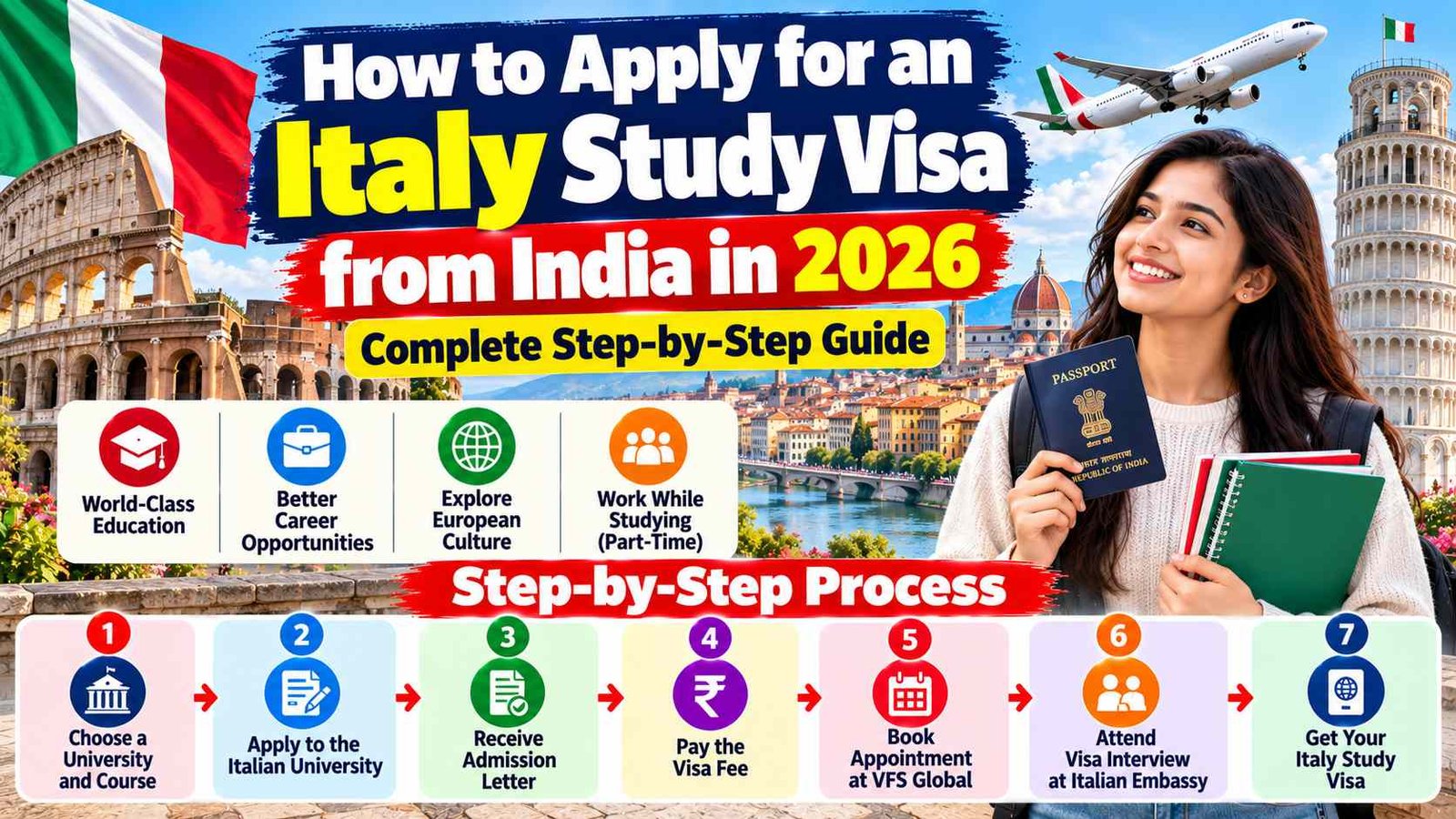
Italy is a popular destination for Indian students who want to pursue higher education in Europe. Italian universities offer bachelor’s degrees, master’s programs, PhD courses, business programs, engineering degrees, fashion courses, art and design programs, and other academic opportunities.
Students are attracted to Italy because of its universities, cultural heritage, international learning environment, and scholarship opportunities. However, Indian students planning to study in Italy must complete the admission process and obtain the appropriate visa before travelling.
In this guide, you will learn how to apply for an Italy study visa from India in 2026, including eligibility requirements, documents, application fees, financial proof, the Universitaly process, visa appointments, and important official links.
1. What Is an Italy Study Visa?
An Italy study visa allows eligible international students to enter Italy for an approved educational purpose.
For most university programs lasting longer than 90 days, students generally need a National Visa (Type D). Shorter courses may require a different visa category, depending on the course and the applicant’s circumstances.
After arriving in Italy on a long-stay study visa, students generally need to apply for a residence permit within the required period.
Before applying, check the visa category that applies to your course and the instructions issued by the Italian consular office responsible for your place of residence.
2. Types of Italy Student Visas
Type D Student Visa
The Type D visa is generally required for university courses and other eligible study programs lasting more than 90 days.
Type C Short-Stay Visa
A Type C visa may be relevant for eligible short courses or study activities lasting up to 90 days. The exact requirements depend on the purpose and duration of the stay.
Visa for Exchange Programs
Students participating in an approved exchange program should follow the visa instructions applicable to their program and institution.
Important: The correct visa category depends on the course, duration, and applicable immigration rules. Confirm your category with the relevant Italian consulate before submitting your application.
3. Eligibility Requirements for an Italy Study Visa from India
Admission to an Italian University
You should apply to an Italian university or eligible higher education institution offering your chosen course.
Admission requirements vary by university, degree level, and subject.
Academic Qualifications
For bachelor’s programs, students generally need to meet the institution’s secondary education requirements. Master’s applicants normally need an appropriate bachelor’s degree, while PhD applicants must meet the university’s research-degree requirements.
Language Requirements
The language requirement depends on whether your course is taught in English or Italian.
Universities may accept English-language test results, Italian-language certificates, or other evidence permitted by their admission rules. Check the exact requirements for your chosen program.
Financial Resources
You must demonstrate that you have sufficient financial resources to support yourself during your studies. The required evidence and amount depend on the current official rules.
Valid Passport
You need a valid passport and must meet the relevant passport and visa application requirements.
Universitaly Pre-Enrolment
For most degree programs covered by the official rules, international students who need a visa must complete the required pre-enrolment process through the Universitaly portal.
Official website: https://www.universitaly.it/
4. Documents Required for an Italy Study Visa
Prepare the documents specified in the current checklist issued by the Italian consulate responsible for your application.
Commonly requested documents may include:
- Valid passport
- Completed visa application form
- Recent passport-size photographs meeting the required specifications
- University admission letter
- Universitaly pre-enrolment confirmation, where required
- Academic certificates and transcripts
- Proof of language proficiency, where required
- Financial evidence, including relevant bank statements
- Evidence of accommodation in Italy
- Medical insurance or other required health coverage evidence
- Travel itinerary or other travel-related documents, if requested
- Proof of payment of the applicable visa fee
- Declaration of Value (DOV) or CIMEA documentation, if required
- Additional documents requested by the consulate
Some documents may need translation, legalisation, or other formalities. Requirements differ according to the consular jurisdiction and the applicant’s educational background.
Do not rely on a general online list alone. Download the latest official study visa checklist for your application location.
5. How to Apply for an Italy Study Visa from India Step by Step
Step 1: Choose an Italian University
Research Italian universities and select a program that matches your academic background and career goals.
Compare tuition fees, course duration, teaching language, admission requirements, accommodation, scholarships, and the cost of living.
Confirm that the institution and course meet the applicable requirements for international student enrolment.
Step 2: Apply for University Admission
Visit the university’s official website and complete its admission process.
Depending on your program, you may need to submit academic transcripts, degree certificates, a CV, a statement of purpose, recommendation letters, and language test results.
Each university has its own application deadlines and admission criteria.
Step 3: Complete Universitaly Pre-Enrolment
After following the university’s admission instructions, complete the required pre-enrolment application through Universitaly.
Official portal: https://www.universitaly.it/
Provide the requested personal, academic, and course information. Follow the university’s instructions regarding validation and any additional documents.
Important: Pre-enrolment or university validation does not guarantee that a visa will be issued. The final visa decision rests with the competent Italian consular authority.
Step 4: Arrange Your Financial Documents
Calculate the amount needed for tuition, accommodation, food, transportation, insurance, and other living expenses.
Prepare genuine financial evidence showing how you will cover these costs. If your parents or another eligible sponsor will support you, check which sponsorship documents and financial records the consulate requires.
Step 5: Check Your Declaration of Value or CIMEA Requirements
Some universities or consulates may require documents to evaluate your previous educational qualifications.
Depending on the applicable instructions, this could involve a Declaration of Value (DOV) or relevant CIMEA documentation.
Ask your university which documents are needed and follow the instructions for your consular jurisdiction.
Step 6: Book a Visa Appointment
Once your pre-enrolment and supporting documents are ready, follow the official instructions for booking a study visa appointment.
In India, the responsible Italian consulate and visa application centre depend on your place of residence and consular jurisdiction.
Use the official VFS Global website or the booking system identified by the relevant Italian consulate. Avoid unofficial appointment sellers.
Official visa information: https://ambnewdelhi.esteri.it/ and https://consbangalore.esteri.it/
Step 7: Complete the Visa Application
Complete the appropriate visa application form according to the official instructions.
Check that your personal details, passport information, course details, and supporting documents are accurate and consistent.
Prepare the required originals, copies, photographs, and other materials listed in the official checklist.
Step 8: Attend Your Appointment
Attend the appointment at the designated visa application centre or consular location.
Submit the required documents, provide biometrics where required, and pay the applicable fees according to the instructions.
Some Italian consular offices require a student video interview. Check the current rules for the office responsible for your application.
Step 9: Wait for the Visa Decision
After submitting your application, follow the official process to track its status where tracking is available.
Long-stay Type D visa applications can take up to 90 days under the information published by some Italian consular offices, and additional checks or document requests may extend the process.
Apply well before your course begins and avoid making non-refundable travel arrangements before your visa is issued.
Step 10: Travel to Italy and Apply for a Residence Permit
After your visa is issued, check the visa dates and travel conditions carefully.
For a long-stay study visa, students generally need to apply for a residence permit (permesso di soggiorno) within eight working days of arriving in Italy.
Follow the current instructions provided by the relevant Italian authorities and your university.
6. Italy Study Visa Fees from India in 2026
The total cost depends on the visa category, consular jurisdiction, application-centre service charges, and any additional services required.
Possible expenses include:
| Expense | What to know |
|---|---|
| Study visa fee | Check the current official fee for your visa category |
| VFS service charge | May be payable in addition to the visa fee |
| University application fee | Depends on the institution |
| Language test | If required by your university |
| Document translation or legalisation | If required |
| DOV or CIMEA documentation | If applicable |
| Travel and accommodation | Additional expenses |
| Health insurance | As required by the visa checklist |
The fee amount in Indian rupees can change. Always check the current fee table on the official website of the relevant Italian consulate or VFS Global before making payment.
Official VFS information: https://visa.vfsglobal.com/ind/en/ita/
7. How Much Bank Balance Is Required for an Italy Study Visa?
The required financial resources depend on the type of study visa and the current rules.
For university enrolment visas, the Italian Ministry of Foreign Affairs lists a minimum annual financial-resource amount of €10,179.85 for academic years 2026–2027 and 2027–2028. Additional funds may be needed for expenses such as tuition fees, the return journey, and other costs not covered by this amount.
Official information: https://www.esteri.it/en/ministero/sportello_info/domandefrequenti/studiare-in-italia/
Can Parents Sponsor an Italian Student?
Eligible family support may be accepted if it is documented according to the consulate’s requirements.
Prepare the relevant bank statements, income evidence, proof of relationship, and sponsorship documents where required.
Can an Education Loan Be Used?
Check with the consulate whether your particular loan documents meet the financial evidence requirements. Do not assume that every loan letter or bank guarantee is automatically accepted.
Should I Show Only the Required Minimum Amount?
No. You should demonstrate genuine and adequately documented financial resources for your circumstances. The minimum reference amount does not automatically guarantee visa approval.
8. Italy Student Visa Interview Questions
Depending on the consular office and your application, you may be asked questions about your study plans and finances.
Why Do You Want to Study in Italy?
Explain your academic reasons for choosing Italy and how the program fits your educational goals.
Why Did You Choose This University?
Mention genuine details about the curriculum, teaching approach, facilities, or academic specialisation.
Who Will Pay for Your Education?
Explain your real funding arrangements, such as family support, personal savings, scholarships, or other eligible sources.
What Are Your Plans After Graduation?
Describe your actual educational and career plans honestly.
Where Will You Stay in Italy?
Explain your accommodation arrangements and provide supporting evidence if required.
Prepare to discuss your documents clearly. Do not memorise false answers or provide misleading information.
9. Italy Student Visa Processing Time
Processing times vary according to the consulate, time of year, application completeness, and whether further checks are needed.
Some Italian consular offices state that long-stay Type D visa applications can take up to 90 days. Additional documents or checks may increase the processing time.
Start your university application early and allow sufficient time for admission, pre-enrolment, document preparation, and the visa appointment.
10. Can Indian Students Work While Studying in Italy?
International students holding an appropriate Italian study residence permit are generally permitted to work part-time within the applicable limits.
The commonly applicable limit is up to 20 hours per week, with an annual maximum of 1,040 hours. Confirm the current conditions with official Italian immigration guidance before accepting employment.
Students should not depend entirely on future part-time earnings to meet their initial visa financial requirements.
11. Scholarships for Indian Students in Italy
Indian students may explore several types of funding opportunities.
University Scholarships
Some Italian universities offer merit-based awards, tuition reductions, or other financial assistance to eligible international students.
Regional Scholarships
Certain Italian regions provide financial aid or benefits to eligible students under regional right-to-study schemes. Eligibility and application procedures vary.
Government Scholarships
Italian government scholarship opportunities may be available for eligible international applicants in selected academic fields and programs.
University Fee Reductions
Some institutions calculate tuition fees according to financial documentation or other eligibility criteria.
Check the official scholarship page of each university and pay attention to deadlines. A scholarship application does not automatically replace the need to satisfy the relevant visa requirements.
12. What to Do After Getting Your Italy Study Visa
Once your visa has been approved:
- Check your passport and visa details.
- Confirm your university enrolment and course start date.
- Arrange accommodation in Italy.
- Organise travel and relevant insurance documents.
- Carry your admission and financial documents when travelling.
- Follow the rules for applying for your residence permit after arrival.
- Complete any required university registration steps.
Keep copies of your important documents and follow the instructions provided by your university and the relevant Italian authorities.
13. Official Websites for Italy Study Visa Applications
Use these official resources to check current information and application requirements.
- Italian Ministry of Foreign Affairs: https://www.esteri.it/en/
- Universitaly – International Students: https://www.universitaly.it/
- Italian Consulate General in Bengaluru – Study in Italy: https://consbangalore.esteri.it/en/servizi-consolari-e-visti/servizi-per-il-cittadino-straniero/study-in-italy/
- Italian Embassy in New Delhi – Student Procedures: https://ambnewdelhi.esteri.it/en/servizi-consolari-e-visti/servizi-per-il-cittadino-straniero/student-procedures-and-services/
- VFS Global Italy Visa Application Information: https://visa.vfsglobal.com/ind/en/ita/
14. Frequently Asked Questions (FAQs)
Can I apply for an Italy study visa from India without IELTS?
Possibly. IELTS is not a universal requirement for every Italian university or visa applicant. The university may accept other language evidence, depending on the course and its admission rules.
How much bank balance is required for an Italy study visa?
For university enrolment visas, the official minimum financial-resource reference for academic years 2026–2027 and 2027–2028 is €10,179.85 per year. Additional costs may need to be covered, and the consulate will assess the evidence provided.
How long does it take to get an Italy student visa?
Processing time depends on the consular office and application. Some offices state that long-stay Type D applications can take up to 90 days, and additional checks can cause delays.
Is Universitaly pre-enrolment mandatory?
It is mandatory for many higher education courses covered by the official rules for international students who require a visa. Check whether your particular course falls within the relevant requirements.
Can I apply for an Italy student visa without an agent?
Yes. You can apply directly through the university, Universitaly, and the official visa application process. An agent is not compulsory.
Can I work in Italy while studying?
Eligible international students may generally work within the permitted limits of their study residence status. Confirm the current rules before beginning employment.
Can I get a scholarship to study in Italy?
Scholarships and financial assistance may be available from universities, regional authorities, or government programs. Eligibility, award amounts, and deadlines vary.
Do I need a residence permit after arriving in Italy?
Students entering on a long-stay study visa generally need to apply for a residence permit within eight working days of arrival.
15. Conclusion: How to Apply for an Italy Study Visa from India
Applying for an Italy study visa from India in 2026 involves choosing an eligible institution, securing admission, completing the required Universitaly pre-enrolment, preparing financial and academic documents, and applying through the appropriate Italian visa process.
Start early because university deadlines, pre-enrolment validation, appointment availability, and visa processing can take time. Always verify the current requirements with your university and the Italian consular office responsible for your application.
Use genuine documents, provide accurate information, and check official sources before paying fees or making travel arrangements.