Studying in the United States is a popular goal for Indian students who want to pursue higher education, gain international exposure, and develop their careers. The USA offers a wide range of academic programs, including undergraduate degrees, master’s programs, doctoral degrees, and vocational courses.
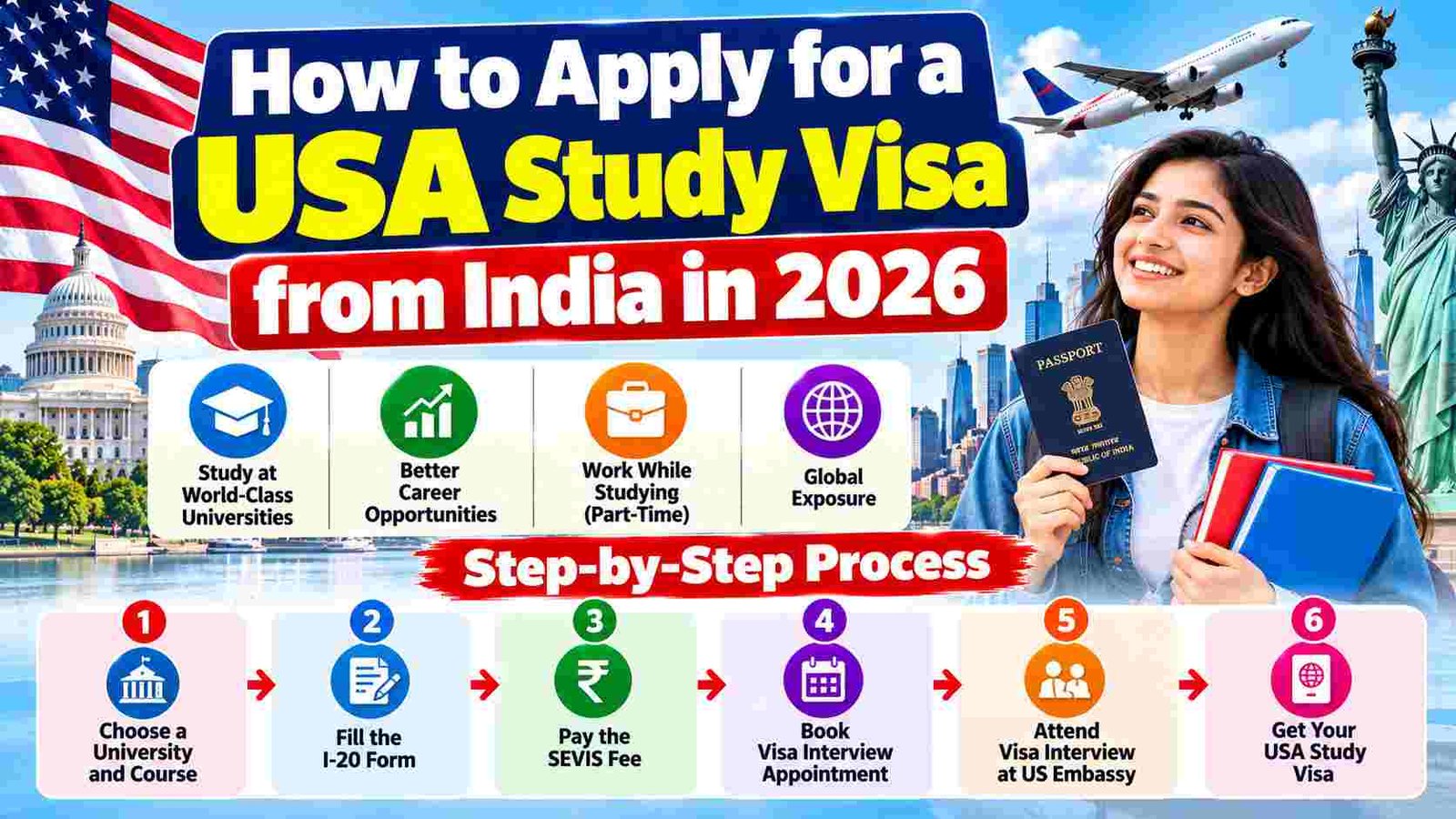
However, before travelling to the United States for education, Indian students must obtain the appropriate student visa. The application process generally involves securing admission to an eligible institution, receiving the required immigration document, paying the applicable fees, completing the online visa application, and attending a visa interview.
In this guide, you will learn how to apply for a USA study visa from India in 2026, including eligibility requirements, documents, application fees, financial proof, interview preparation, and official application links.
1. What Is a USA Student Visa?
A USA student visa allows eligible international students to travel to the United States for an approved course of study. The appropriate visa category depends on the type of educational program and the institution.
Indian students should understand the main student and exchange visitor visa categories before starting the application process.
2. Types of USA Student Visas
F-1 Student Visa
The F-1 visa is generally used by international students enrolling in academic programs at eligible US universities, colleges, high schools, language schools, and other approved academic institutions.
It is commonly used for bachelor’s degrees, master’s degrees, PhD programs, and eligible English-language courses.
M-1 Student Visa
The M-1 visa is intended for eligible vocational or non-academic study, excluding language training. It may apply to certain technical and career-focused educational programs.
J-1 Exchange Visitor Visa
The J-1 visa is for participants in approved exchange visitor programs. It can cover certain exchange students, scholars, researchers, and other eligible participants.
Important: Choose the visa category that matches your program. Most Indian students pursuing a conventional university degree will generally need to explore the F-1 category.
3. Eligibility Requirements for a USA Student Visa from India
Before applying for a student visa, you should meet the requirements for admission to your chosen institution and the relevant visa category.
Educational Qualification
Your academic qualifications must meet the admission requirements of the US institution.
For example:
- Students applying for a bachelor’s degree generally need to have completed the equivalent of secondary education required by the university.
- Students applying for a master’s degree generally need a relevant bachelor’s degree.
- Doctoral applicants usually need to meet the institution’s graduate admission requirements.
- Vocational students must meet the requirements of their chosen program.
There is no single academic qualification that applies to every US student visa applicant.
English Language Proficiency
Many US universities require proof of English proficiency. Depending on the institution and course, accepted tests may include IELTS, TOEFL, PTE Academic, or other approved assessments.
Some universities offer alternative ways to demonstrate English proficiency. Always check the requirements of your chosen institution.
Admission to an Eligible Institution
For an F-1 or M-1 visa, you generally need admission to a school certified by the Student and Exchange Visitor Program (SEVP).
You can search for eligible schools through the official US government website:
Financial Requirements
You must be prepared to demonstrate how you will pay for tuition, living expenses, and other educational costs.
Your financial evidence should match the costs shown by your institution and your actual funding arrangements.
Valid Passport
You need a passport suitable for international travel. Check its validity before starting your application and follow the current instructions applicable to your circumstances.
4. Documents Required for a USA Student Visa
Prepare your documents before the visa interview. The exact requirements may vary depending on your visa category and circumstances.
Common documents include:
- Valid passport
- Form I-20 for an F-1 or M-1 student
- DS-160 confirmation page
- SEVIS I-901 fee payment confirmation, when applicable
- Visa application fee payment confirmation, as instructed
- University admission letter
- Academic transcripts and certificates
- English-language test scores, if applicable
- Standardized test scores, if required by the institution
- Bank statements and other financial evidence
- Education loan sanction letter, if applicable
- Scholarship or assistantship documentation, if applicable
- Sponsor’s financial documents, if someone else is funding your education
- Photograph meeting the official visa requirements
Keep both digital and printed copies where appropriate. Follow the specific instructions provided by the US Embassy or Consulate handling your application.
5. How to Apply for a USA Study Visa from India Step by Step
Step 1: Choose a University or College in the USA
Begin by researching US institutions that offer your preferred course.
Compare tuition fees, living expenses, admission requirements, scholarships, program duration, and career opportunities. Confirm that the institution is SEVP-certified if you plan to apply for an F-1 or M-1 visa.
Step 2: Apply for Admission
Visit the university’s official website and complete the admission application.
You may need to submit academic transcripts, test scores, recommendation letters, a statement of purpose, a résumé, and other documents depending on the course.
If the institution accepts your application, follow its instructions to confirm your admission and complete the required enrollment steps.
Step 3: Receive Form I-20
After accepting an eligible student, the institution generally creates the appropriate Form I-20 through SEVIS for an F-1 or M-1 student.
Review the document carefully. Check your name, program details, school information, estimated expenses, and SEVIS identification number.
Contact your institution’s designated school official if you find an error.
Step 4: Pay the SEVIS I-901 Fee
Eligible F-1 and M-1 students generally need to pay the SEVIS I-901 fee before the visa interview.
The commonly applicable fee for F-1 and M-1 students is US$350, but verify the current amount and your payment requirements on the official website before paying.
Official website: https://www.fmjfee.com/
Save your payment confirmation for your records and interview preparation.
Step 5: Complete the DS-160 Online Application
Complete Form DS-160 through the official Consular Electronic Application Center.
Official website: https://ceac.state.gov/genniv/
You will need personal details, passport information, travel information, educational details, and information about your intended US school. Students should have their Form I-20 available because the DS-160 asks for relevant school and SEVIS information.
Important tips:
- Enter accurate information.
- Make sure your details match your passport and school documents.
- Review your answers before submitting.
- Save and print the DS-160 confirmation page containing the barcode.
Step 6: Pay the Student Visa Application Fee
The standard application processing fee for an F or M nonimmigrant student visa is generally US$185 under the published fee schedule.
Check the latest fee and payment instructions on the official US Department of State website and the US Embassy or Consulate instructions for India.
Visa application fees are generally non-refundable, so confirm that you are applying under the correct category before making payment.
Step 7: Schedule Your Visa Appointment
Follow the current official instructions for applicants applying from India to schedule the required visa appointment or appointments.
Appointment availability can change. Check the relevant official US visa appointment website rather than relying on unofficial social media posts or agents.
Apply early enough to account for appointment availability, possible administrative processing, and your university’s course start date.
Step 8: Prepare Your Documents
Organize your passport, Form I-20, DS-160 confirmation, fee receipts, academic records, financial evidence, and other documents relevant to your case.
You should understand your course, university, estimated expenses, and funding arrangements clearly.
Step 9: Attend the Visa Interview
Attend your appointment at the location and time specified in your instructions. Answer questions honestly and directly.
The consular officer may ask about:
- Your chosen course and university
- Your academic background
- Why you selected the United States
- How you will pay for your education
- Your future educational or career plans
Do not memorize false answers or provide misleading documents. Your responses should accurately reflect your real study plans and circumstances.
Step 10: Check Your Visa Status
After the interview, follow the official instructions to check your application status and passport return arrangements.
Approval is not guaranteed. Some applications may require additional administrative processing or documents.
Do not make non-refundable travel arrangements until you understand your visa status and have checked the applicable travel requirements.
6. USA Student Visa Fees from India in 2026
The following table lists two commonly applicable government fees for F-1 students. Always confirm the current amount before making payment.
| Fee | Commonly applicable amount |
|---|---|
| Student visa application processing fee | US$185 |
| SEVIS I-901 fee for F-1 students | US$350 |
| Combined amount for these two fees | US$535 |
The combined amount does not include university application fees, tuition deposits, English-language tests, document preparation, travel, accommodation, or other expenses. Additional requirements or fees may apply in particular circumstances.
University Application Fees
Universities may charge separate application fees. The amount depends on the institution and program. Some universities offer fee waivers to eligible applicants.
Tuition and Living Expenses
Your overall study budget should include tuition, housing, food, health insurance, transportation, books, and personal expenses. These costs vary considerably by university, program, and city.
7. How Much Bank Balance Is Required for a USA Student Visa?
There is no single fixed bank balance that guarantees a US student visa.
Your financial plan should demonstrate that you can cover the educational and living costs associated with your program, taking into account the funding information documented by your institution and your actual financial resources.
Tuition Fees and Living Expenses
Review the estimated expenses listed on your Form I-20 and the university’s official cost-of-attendance information.
Calculate the funds needed for tuition, accommodation, food, health insurance, transportation, and other essential expenses.
Education Loan
An education loan may help fund your studies. Keep the official loan sanction letter and other required supporting documents.
Make sure the loan amount and disbursement arrangements are consistent with your education budget.
Parent or Sponsor Funding
If your parents, relatives, or another sponsor will fund your education, prepare genuine evidence of their financial ability and their intended support.
Depending on the circumstances, this may include bank statements, income documents, sponsorship information, and evidence of the relationship.
Scholarships and Assistantships
If you receive a scholarship, fellowship, or assistantship, keep the official award letter showing the amount and terms of the funding.
Do not show borrowed or temporarily arranged money as though it were genuinely available for your education. Your documents should accurately represent your financial situation.
8. USA Student Visa Interview Questions and Answers
The following are sample questions and answer frameworks. Adapt them to your actual circumstances rather than memorizing them word for word.
Question 1: Why Do You Want to Study in the USA?
Sample answer: “I chose the USA because the program I selected offers relevant coursework and learning opportunities that match my academic and career goals. I researched the curriculum and compared it with other available options before making my decision.”
Explain the specific reasons that apply to you.
Question 2: Why Did You Choose This University?
Sample answer: “I selected this university because its program includes subjects and practical learning opportunities relevant to my goals. I also reviewed the curriculum, faculty information, and total study costs.”
Mention genuine details about your institution.
Question 3: Who Will Pay for Your Education?
Sample answer: “My education will be funded through [my family savings, an approved education loan, a scholarship, or another genuine source]. I have prepared the supporting financial documents.”
Use only the funding sources that actually apply to you.
Question 4: What Are Your Plans After Graduation?
Sample answer: “My plan is to use the knowledge and skills gained through this program to pursue opportunities related to my field. My longer-term plans are [explain your genuine intentions].”
Answer honestly about your circumstances and intentions.
Question 5: How Will You Cover Your Living Expenses?
Sample answer: “I have prepared a budget based on the university’s estimated costs. My living expenses will be covered through [explain your genuine source of funding], supported by the relevant documents.”
9. How to Prepare for a USA Student Visa Interview
Preparation can help you explain your study plans clearly.
- Review your Form I-20 and DS-160 information.
- Know the name and location of your institution.
- Understand your course structure and program duration.
- Be familiar with tuition and living expenses.
- Know how your education will be funded.
- Carry the documents requested by the relevant consular instructions.
- Answer questions truthfully and concisely.
- Avoid submitting false documents or making misleading claims.
A strong application is based on genuine academic plans, accurate information, and appropriate supporting evidence. No consultant or agent can guarantee visa approval.
10. USA Student Visa Processing Time from India
The processing time varies by appointment location, season, visa category, and individual application circumstances.
Visa Appointment Waiting Time
Appointment availability can change frequently. Check the official appointment information for the location where you will apply.
Administrative Processing
Some applications require additional review after the interview. The duration can vary, and there is no universal processing timeline that applies to every applicant.
When Should You Apply?
Start researching universities well before your intended intake. After admission and receipt of Form I-20, begin the visa process as early as the official instructions allow.
The US Department of State states that new students’ F and M visas may be issued up to 365 days before the start date of the course, but students generally cannot enter the United States more than 30 days before that start date. Check the current rules for your circumstances.
11. Common Reasons for USA Student Visa Refusal
A visa application may be refused if the applicant does not establish eligibility under the applicable immigration law. Issues may include:
Inadequate Financial Evidence
The documents may not sufficiently demonstrate how the student will pay for the program and related expenses.
Unclear Study Plans
The applicant may struggle to explain the chosen course, institution, or educational goals.
Inconsistent Information
Differences between the application form, academic records, financial evidence, and interview answers may raise questions.
Failure to Establish Eligibility
The applicant may not satisfy the legal requirements for the visa category.
There is no guaranteed way to secure approval. If an application is refused, read the refusal information, understand the reason, and consider whether you can provide relevant additional evidence or address the issue before applying again.
12. Can Indian Students Work on an F-1 Student Visa?
F-1 students may be eligible for certain types of employment, but work is subject to immigration rules and authorization requirements.
On-Campus Employment
Eligible F-1 students may work on campus subject to the applicable rules, including limits during the academic term.
Curricular Practical Training (CPT)
CPT may allow eligible students to participate in practical training that is an integral part of their established curriculum. Authorization must be obtained before starting the relevant employment.
Optional Practical Training (OPT)
OPT may provide eligible students with temporary work authorization related to their field of study, subject to applicable rules and approval requirements.
Certain qualifying STEM degree programs may offer an extension, but eligibility conditions apply.
Important: Do not start employment or practical training unless you have confirmed that it is permitted under your status and have obtained any required authorization.
13. Scholarships for Indian Students in the USA
Scholarships can help reduce the cost of studying in the United States.
University Scholarships
Many universities offer scholarships based on academic achievement, program requirements, or other eligibility criteria.
Merit-Based Scholarships
These awards may consider grades, test scores, leadership, achievements, and other academic or extracurricular factors.
Graduate Assistantships
Some graduate programs offer teaching or research assistantships that may include a stipend or tuition support. Availability depends on the institution and department.
External Funding
Indian students can also research eligible government, foundation, and private funding opportunities.
Always verify eligibility, deadlines, award conditions, and whether the funding can be used for your chosen program.
14. What to Do After Getting Your USA Student Visa
Once your visa has been issued, complete the remaining preparations before travelling.
- Check your passport and visa details for errors.
- Confirm your course start date and Form I-20 information.
- Arrange accommodation and transportation.
- Keep your passport, visa, I-20, and other relevant documents accessible during travel.
- Review your institution’s arrival and orientation instructions.
- Check current US entry requirements and permitted arrival dates.
Remember that a visa allows you to travel to a US port of entry and request admission. The final admission decision is made by the relevant US border authorities.
15. Official Websites for USA Student Visa Applications
Use official government and institutional resources for accurate information.
- US Department of State – Student Visa Information: https://travel.state.gov/content/travel/en/us-visas/study/student-visa.html
- DS-160 Online Application: https://ceac.state.gov/genniv/
- SEVIS I-901 Fee Payment: https://www.fmjfee.com/
- SEVP-Certified School Search: https://studyinthestates.dhs.gov/school-search
- EducationUSA India: https://educationusa.in/
Use these resources to check current application instructions, fees, school eligibility, and other official requirements.
16. Frequently Asked Questions (FAQs)
Can I apply for a USA study visa from India without IELTS?
Possibly. IELTS is not a universal US visa requirement. However, the university may require IELTS, TOEFL, or another form of English proficiency evidence. Check your institution’s admission policy.
How much does a USA student visa cost in 2026?
The commonly applicable F-1 visa application fee is US$185, and the SEVIS I-901 fee is US$350. Verify the current fees before payment. University and travel costs are additional.
How much bank balance is required for a USA student visa?
There is no universal fixed amount. Your financial evidence should demonstrate sufficient genuine funding for the costs associated with your program and circumstances.
Can I apply for a USA student visa without an agent?
Yes. You can apply directly using official US government websites and your institution’s guidance. An agent is not mandatory.
Can my parents sponsor my USA education?
Parents may fund a student’s education. Prepare genuine supporting financial evidence and follow the applicable application instructions.
How long does it take to get a USA student visa?
The timeline varies depending on admission, document preparation, appointment availability, and any additional administrative processing.
Can I study in the USA after completing Class 12 in India?
Yes, Indian students may apply to suitable US undergraduate programs after Class 12 if they meet the institution’s admission requirements and obtain the appropriate visa.
What happens if my USA student visa is refused?
Read the refusal explanation and follow the official instructions. You may apply again if appropriate, but a new application does not guarantee approval.
17. Conclusion: How to Apply for a USA Study Visa from India
Applying for a USA study visa from India in 2026 requires careful planning, admission to an eligible institution, accurate application forms, appropriate financial evidence, and preparation for the visa interview.
Start by researching universities and confirming their admission requirements. After receiving the required immigration document, complete the visa application and fee payments according to current official instructions.
Most importantly, use genuine documents, provide accurate information, and verify fees and appointment requirements through official US government sources. With careful preparation, you can better understand the process and make informed decisions about studying in the United States.